The Hireling Shepherd
William Holman Hunt

📌 Pin it
In a Surrey meadow, a shepherd shows his companion a death's-head hawkmoth while, behind them, his sheep wander unguarded into a wheat field. The scene looks like an idyll — sunlight, butterflies, a pretty girl — but the title gives it away. Hunt painted it in Surrey at the same time, and in close collaboration, as Millais painted Ophelia on the Hogsmill River nearby: two friends disturbing the English pastoral with a quiet violation.
Hunt later explained the parable: the shepherd is a 'hireling' pastor, the kind denounced in the Gospels, who tends his flock only when it suits him. While he flirts, the sheep — his congregation — stray into danger. The moth in his hand, marked with a skull, is death itself, waved casually under a young woman's nose.
Exhibited at the Royal Academy in 1852 with an epigraph from King Lear — 'Sleepest or wakest thou, jolly shepherd? Thy sheep be in the corn' — the painting puzzled viewers who expected a simple rustic scene. It is now read as the Pre-Raphaelites' sharpest joke: a sunny meadow that is really a sermon.
Frequently asked
What does The Hireling Shepherd mean?
It is a parable of negligent clergy: the shepherd is a 'hireling' pastor who flirts while his sheep — his congregation — stray into the corn. The death's-head moth in his hand is a memento mori.
What is its connection to Ophelia?
Hunt painted it in Surrey in 1851 while his friend Millais painted Ophelia on the Hogsmill River nearby; the two friends worked in close collaboration that summer.
Where is The Hireling Shepherd?
Manchester Art Gallery.
Why it matters today
The Hireling Shepherd proved the Pre-Raphaelites could hide a sermon inside a sunny meadow — and made the 'hidden meaning' picture a Victorian genre of its own.
More in Art & Painters
All →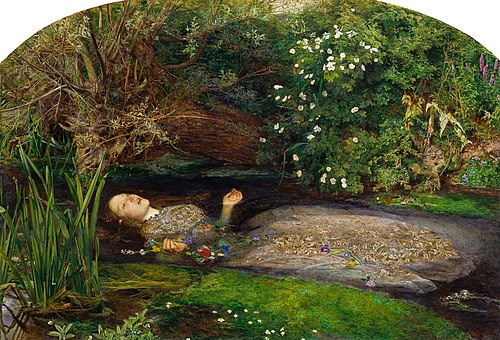
Ophelia
A drowned Shakespearean heroine, painted leaf by leaf on a Surrey riverbank — the image that made the Pre-Raphaelites immortal.

The Lady of Shalott
Tennyson's cursed weaver, caught at the moment she turns to look at Camelot — the most reproduced Victorian painting of them all.

Flaming June
A sleeping woman wrapped in translucent orange silk — the single most famous image of the Aesthetic movement, lost and found again.