Flaming June
Frederic Leighton

📌 Pin it
Frederic Leighton, President of the Royal Academy from 1878, was the grandest figure in Victorian art — the only painter ever raised to the peerage, ennobled as Baron Leighton in 1896, the day before his death. Flaming June, painted in 1895, is his masterpiece: a woman asleep in a blaze of transparent orange drapery, one arm pillowing her head, sprigs of oleander — poisonous, note — above her.
The painting is said to have begun with a model dozing in Leighton's studio; he sketched the pose of utter, heat-struck surrender and built the composition around it. There is no story, no moral, no literature behind it: that was the point. The Aesthetic movement's creed was art for art's sake, and Flaming June is its purest statement — beauty as its own justification.
When Victorian art fell from fashion in the early twentieth century, Flaming June vanished into obscurity, reportedly changing hands for a pittance. In 1963 the Puerto Rican industrialist Luis A. Ferré bought it in Amsterdam and made it the crown jewel of his new Museo de Arte de Ponce. Its rediscovery helped trigger the great Victorian art revival of the 1960s and 70s.
Frequently asked
Where is Flaming June?
The Museo de Arte de Ponce, Puerto Rico, where it has hung since the industrialist Luis A. Ferré bought it in Amsterdam in 1963 and made it the museum's crown jewel.
Who was the model for Flaming June?
The model is traditionally identified as Dorothy Dene, the actress who was Leighton's muse for many years — though the painting is said to have begun with a sketch of a model simply dozing in his studio.
Why is it called Flaming June?
For the sheet of flaming orange silk that wraps the sleeping figure — the painting's entire subject is colour, heat and surrender.
Why it matters today
Flaming June became the poster image of the Aesthetic movement, and its 1960s rediscovery sparked the modern revival of Victorian art.
More in Art & Painters
All →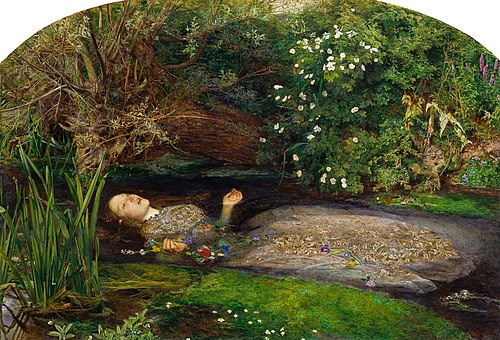
Ophelia
A drowned Shakespearean heroine, painted leaf by leaf on a Surrey riverbank — the image that made the Pre-Raphaelites immortal.

The Lady of Shalott
Tennyson's cursed weaver, caught at the moment she turns to look at Camelot — the most reproduced Victorian painting of them all.

Beata Beatrix
Rossetti's memorial to his dead wife, caught at the instant her soul takes flight — love, grief and laudanum in a single image.