Beata Beatrix
Dante Gabriel Rossetti

📌 Pin it
In February 1862, Elizabeth Siddal — Rossetti's wife, model and a gifted artist herself — died of a laudanum overdose at 32. Rossetti buried the only complete manuscript of his poems with her. Beata Beatrix, 'Blessed Beatrice,' begun two years later, is his monument to her: Siddal transfigured as Dante's Beatrice at the moment of death, her head tilted back, hands open, a red dove dropping a white poppy — the flower of sleep and death — into her palm.
The painting's details are a private language of mourning. The sundial beside her casts its shadow at the hour of her death; in the background, Dante gazes at Beatrice across the river of death while Love leads him by the hand. Rossetti worked on the canvas for six years, returning to it again and again — grief as a long studio session.
In 1869, as his own career faltered, Rossetti had Siddal's coffin exhumed at night to retrieve the buried poems, which he published to acclaim. The exhumation scandalized even his friends — but it completed the painting's story: a man who could neither bury his wife nor his work.
Frequently asked
Who is Beata Beatrix?
Dante's Beatrice, the idealized beloved of the Divine Comedy — portrayed by Rossetti's late wife Elizabeth Siddal at the moment of her death, her soul taking flight.
What does the dove mean in Beata Beatrix?
The red dove is a messenger between worlds, dropping a white poppy — the flower of sleep and death — into Beatrice's open hands.
Where is Beata Beatrix?
Tate Britain, London.
Why it matters today
Beata Beatrix made the beautiful dead woman the central icon of Aestheticism — an image artists would imitate, and later generations would interrogate, for a century.
More in Art & Painters
All →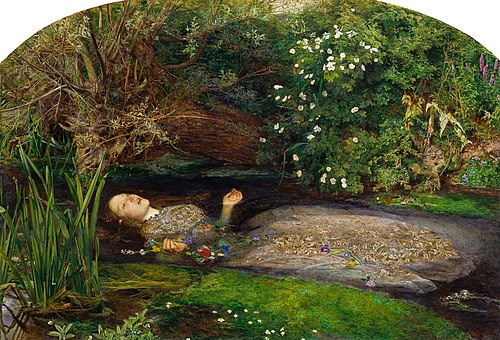
Ophelia
A drowned Shakespearean heroine, painted leaf by leaf on a Surrey riverbank — the image that made the Pre-Raphaelites immortal.

The Lady of Shalott
Tennyson's cursed weaver, caught at the moment she turns to look at Camelot — the most reproduced Victorian painting of them all.

Flaming June
A sleeping woman wrapped in translucent orange silk — the single most famous image of the Aesthetic movement, lost and found again.