The John Rylands Library
A cathedral built for books, 1900

📌 Pin it
John Rylands died in December 1888, Manchester's first multi-millionaire, his fortune built on textiles. His widow Enriqueta Augustina Rylands — born in Havana in 1843, married to a man more than forty years her senior — decided his memorial would be a library for the city, and she meant it to be an architectural ornament to Manchester. She bought a site on Deansgate in 1889 and commissioned the architect Basil Champneys, who designed a neo-Gothic building in Cumbrian sandstone that looks, deliberately, like a church: its great reading room is modelled on a cathedral nave, with a vaulted ceiling and tall traceried windows.
Construction began in 1890 and took ten years; the library was inaugurated on 6 October 1899 — the Rylands' wedding anniversary, the day Enriqueta also became the first woman admitted to the Freedom of the City of Manchester — and opened to readers and visitors on 1 January 1900, the first day of the new century. It held some 40,000 books at the inauguration, and it was one of the first public buildings in Manchester to be electrically lit. Enriqueta was closely involved in every detail, from the building to the collections.
Today the library is part of the University of Manchester and houses its rare books and manuscripts, including the St John Fragment — Papyrus P52, the earliest surviving fragment of the New Testament — and a Gutenberg Bible. It is Grade I listed, free to enter, and still one of the most beautiful reading rooms in Britain: a church built for books, raised by a widow in memory of her husband.
Frequently asked
Who was John Rylands?
He was a textile magnate — Manchester's first multi-millionaire — who built the firm of Rylands & Sons into one of the great cotton businesses of the age. His widow Enriqueta used part of the fortune he left her to build the library as his memorial.
Why does the library look like a church?
Deliberately. Architect Basil Champneys modelled the great reading room on a cathedral nave, with a vaulted ceiling and tall traceried windows, because the library was intended to be largely theological — a temple of learning as much as a storehouse of books.
Can you visit the John Rylands Library?
Yes — it is free to enter, on Deansgate in Manchester city centre, and visitors can see the historic reading room and exhibitions drawn from its rare books and manuscripts.
Why it matters today
The John Rylands showed that a public library could be a civic cathedral — and it set the pattern for the great endowed libraries that followed, while its collections, from the St John Fragment to the Gutenberg Bible, made Manchester a centre of biblical scholarship.
More in Architecture & Design
All →
The Crystal Palace
A gardener's glasshouse scaled up to hold the world — 1,848 feet of iron and glass, six million visitors in a single summer, then a single night of fire.
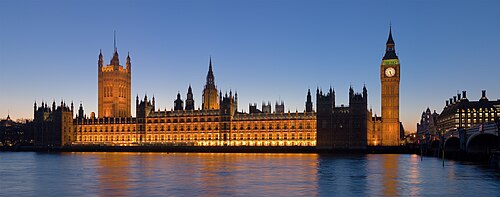
The Houses of Parliament
Rebuilt from the ashes of the 1834 fire, the Palace of Westminster made Gothic Revival the face of British democracy — and gave London its most famous silhouette.

The Albert Memorial
A 176-foot Gothic shrine in Kensington Gardens — Queen Victoria's monument to the husband she lost, crowded with 169 sculpted geniuses and four continents.