The Crystal Palace
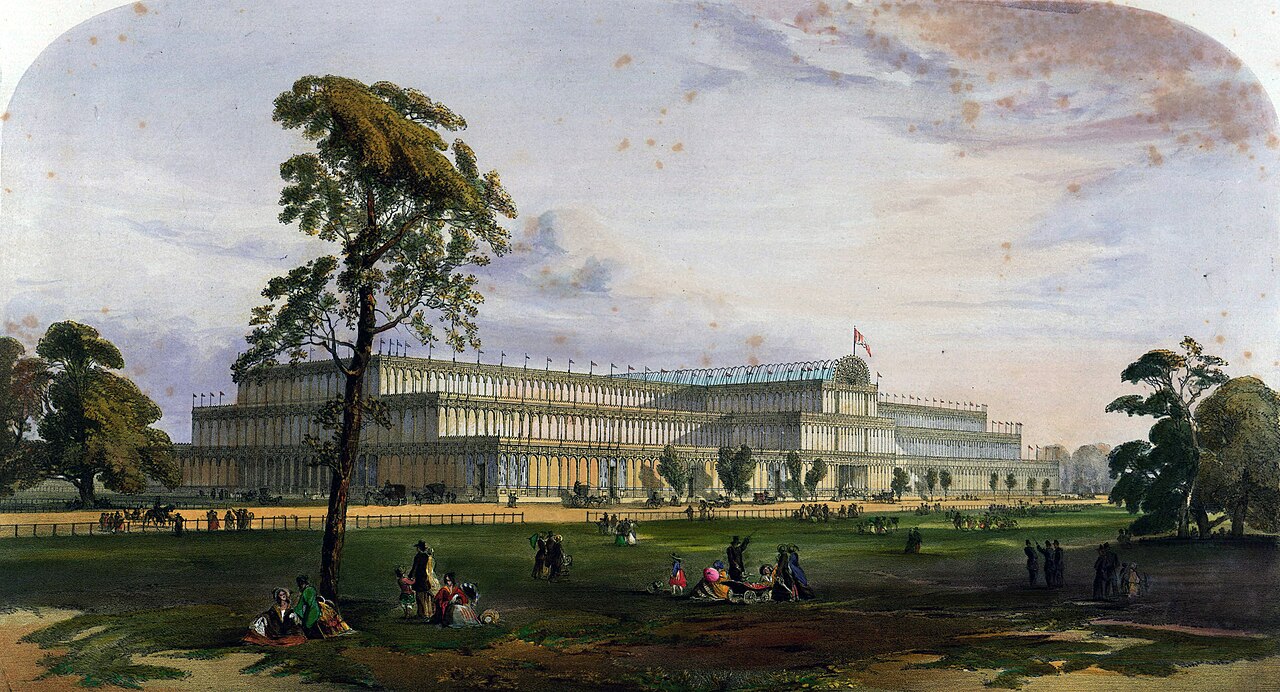
Paxton's palace of glass, 1851
📌 Pin it
The Great Exhibition of the Works of Industry of All Nations was Prince Albert's idea, organised with the civil servant Henry Cole — and it needed a building no one had ever built. The official Building Committee considered 245 designs and produced its own brick scheme, which was widely ridiculed. Then Joseph Paxton, head gardener at Chatsworth in Derbyshire, sketched an alternative on a piece of blotting paper on 11 June 1850: a vast glasshouse, inspired by the great lily house he had built for the Duke of Devonshire. His scheme was accepted on 15 July, and the contractors Fox, Henderson & Co. raised it in just 39 weeks, from prefabricated cast-iron parts and glass, assembled on site like a giant kit.
Opened by Queen Victoria on 1 May 1851, the palace was the largest enclosed space in the world: its main body measured 1,848 feet long and 408 feet wide, with a barrel-vaulted transept 108 feet high, raised to enclose a row of mature elm trees that Paxton refused to fell. Nearly 14,000 exhibitors from 34 nations showed more than 100,000 objects under 293,000 panes of glass made by Chance Brothers of Smethwick, and more than six million visitors came before the exhibition closed on 15 October 1851. The satirical magazine Punch gave the building the name that stuck: the Crystal Palace.
When the exhibition closed, a company of businessmen bought the building, took it down, and rebuilt it larger on Sydenham Hill in south London, where it reopened in June 1854 as a palace of concerts, exhibitions and winter gardens. It entertained London for 82 years, until the night of 30 November 1936, when it burned to the ground in a single night; the surviving water towers were demolished in 1941 as a landmark for German bombers. What remains is Crystal Palace Park — its terraces, sphinxes and, most famously, the life-sized dinosaurs Benjamin Waterhouse Hawkins unveiled beside the palace in 1854, which still stand there today.
Frequently asked
Why was it called the Crystal Palace?
The name was a joke by Punch magazine — the building was a palace made almost entirely of clear glass, and the nickname stuck so firmly that the whole district of south London is still called Crystal Palace after it.
How could such a huge building go up in 39 weeks?
Because it was prefabricated: standardised cast-iron columns, girders and glass panes were made in factories in Birmingham and Smethwick, then bolted together on site like a giant kit — the first building ever raised that way at such a scale.
Can you still see anything of the Crystal Palace?
The building is gone, but its park survives: the terraces and sphinxes it stood on, the subway under the site, and Benjamin Waterhouse Hawkins's life-sized dinosaurs of 1854, which still stand in Crystal Palace Park.
Why it matters today
The Crystal Palace invented the prefabricated building — standardised parts, factory-made and assembled on site — and every glass exhibition hall, railway terminus, airport terminal and shopping mall since descends from Paxton's glasshouse.
More in Architecture & Design
All →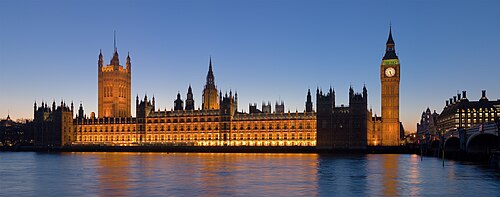
The Houses of Parliament
Rebuilt from the ashes of the 1834 fire, the Palace of Westminster made Gothic Revival the face of British democracy — and gave London its most famous silhouette.

The Albert Memorial
A 176-foot Gothic shrine in Kensington Gardens — Queen Victoria's monument to the husband she lost, crowded with 169 sculpted geniuses and four continents.
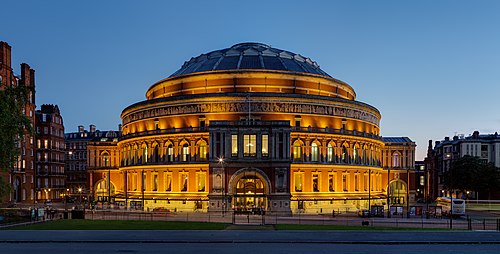
The Royal Albert Hall
An elliptical amphitheatre of red brick and terracotta, opened by a grieving queen in her husband's memory — and home to the Proms every summer since 1941.