Charles Darwin
Naturalist
📌 Pin it
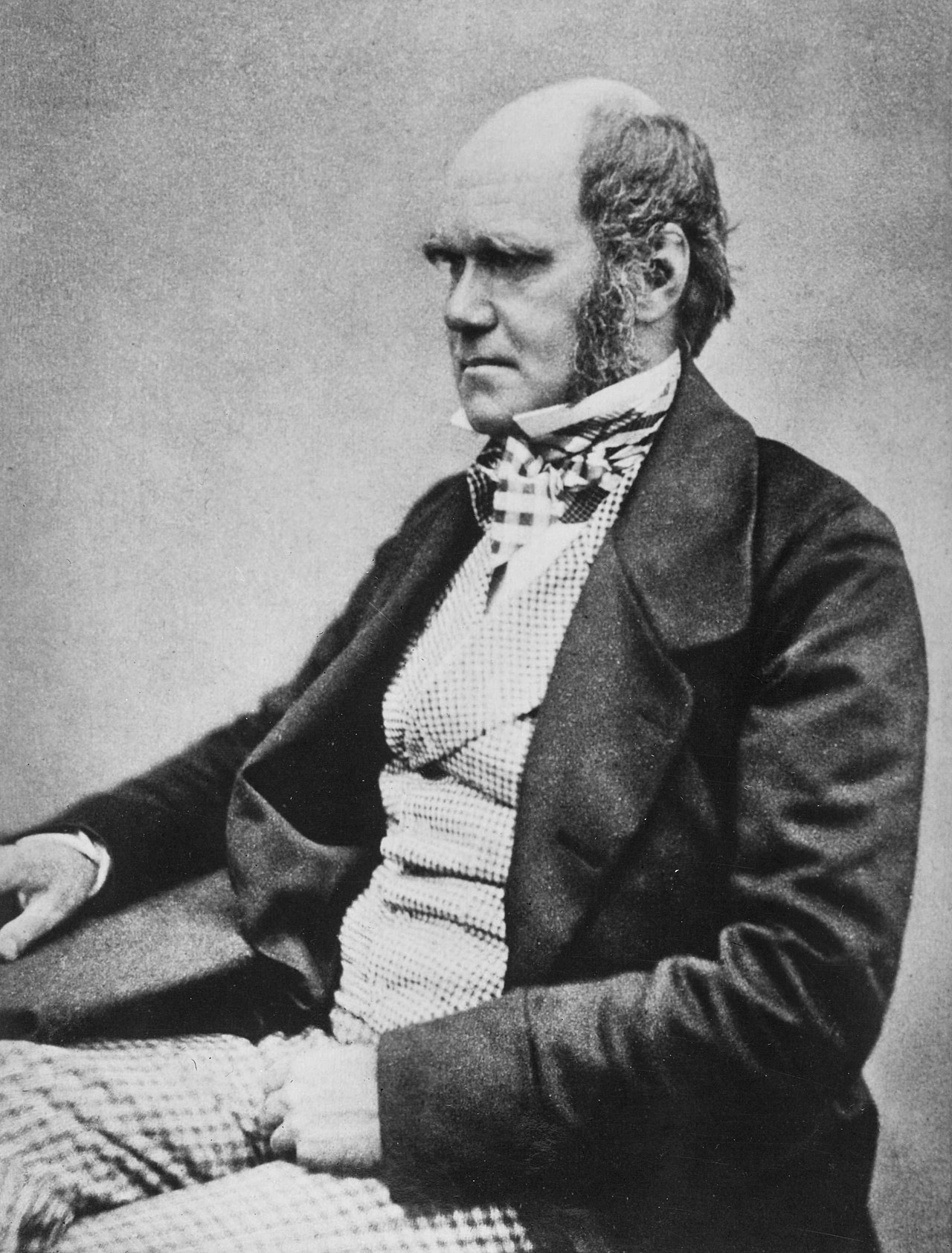
Charles Robert Darwin was born on 12 February 1809 in Shrewsbury, the son of a prosperous physician, and as a young man he seemed an unlikely revolutionary. After abandoning medical studies at Edinburgh and taking a degree at Cambridge, he sailed in December 1831 as the gentleman companion and naturalist aboard HMS Beagle, a five-year voyage around the world that carried him to South America, the Galápagos Islands, Australia, and Africa. The finches, mockingbirds, and fossil mammals he collected, and the notebooks he filled, gave him the raw material for a theory he would spend more than twenty years testing before he dared publish it.
In 1842 Darwin moved with his wife Emma to Down House in the Kent village of Downe, and it was there, in his study and garden, that the theory took its final shape. Spurred by a letter from Alfred Russel Wallace in 1858, who had independently arrived at a similar idea, Darwin rushed his great work into print: On the Origin of Species by Means of Natural Selection was published on 24 November 1859, and the entire first printing of 1,250 copies sold out on the day of publication. The book argued that all living things descend from common ancestors, and that the differences between them arise because individuals with traits better suited to their surroundings leave more offspring — natural selection.
Darwin spent the remaining twenty-three years of his life defending and extending the theory, publishing The Descent of Man in 1871 and detailed studies of orchids, insect-eating plants, and earthworms. He died at Down House on 19 April 1882, aged 73, and was buried in Westminster Abbey — a national honour for a man whose quiet Kentish garden had changed humanity's understanding of itself.
Frequently asked
What did Charles Darwin actually discover?
Darwin showed that all species descend from common ancestors and change over time through natural selection — individuals with traits better suited to their environment are more likely to survive and reproduce, so those traits spread through a population.
When was On the Origin of Species published?
It was published on 24 November 1859 by John Murray of London. The first printing of 1,250 copies sold out on publication day, and Darwin spent the rest of his life revising it through six editions.
Can you visit Darwin's home?
Yes — Down House in Downe, Kent, is open to the public as an English Heritage museum, with Darwin's study, his gardens, and the Sandwalk path where he walked daily while thinking through his theory.
Why it matters today
Every modern biology textbook, museum display, and conservation programme rests on Darwin's insight that species change over time through natural selection; his framework also underpins modern medicine's understanding of antibiotic resistance and the evolutionary history of viruses.
More in Science & Medicine
All →
Florence Nightingale
The 'Lady with the Lamp' who transformed nursing into a trained profession and used statistics to prove that clean hospitals save lives.

John Snow
The doctor who traced a deadly cholera outbreak to a single Soho water pump and founded the science of epidemiology.

Joseph Lister
The surgeon who turned Pasteur's germ theory into antiseptic surgery, using carbolic acid to make operations survivable.